


From Hull to Marrakesh: Sharing Our Brain Injury Research with the World
23.01.26 By Beth-Louise Speed
Dr Alex Wray and Emma Branch reflect on their experience of sharing the stories and experiences of 13 local families from Hull at an international audience of rehabilitation experts at the 19th World Congress of the International Society of Physical and Rehabilitation Medicine (ISPRM) in Marrakesh.
By Dr Alex Wray, Health Services Research Fellow; Nathalie Martin, Service Delivery Manager, P.A.U.L for Brain Recovery; and Emma Branch, Family Support Worker
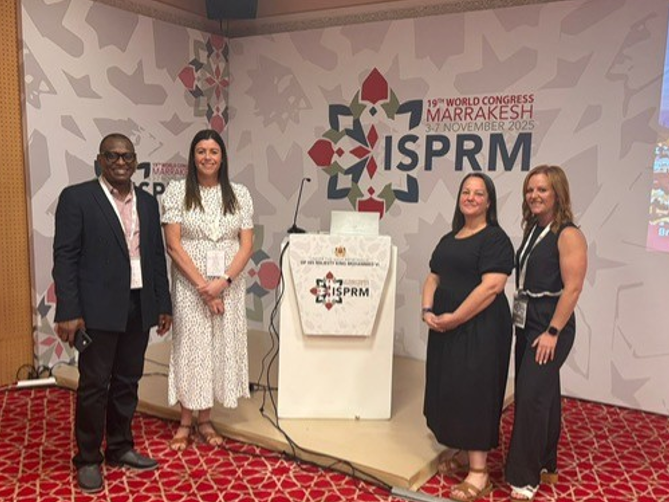
When we first started our Ideas Fund project exploring how to better support families living with acquired brain injury (ABI), we never imagined it would take us all the way to Morocco. But this November, our work, born out of the stories and experiences of 13 local families in Hull, was shared with an international audience of rehabilitation experts at the 19th World Congress of the International Society of Physical and Rehabilitation Medicine (ISPRM) in Marrakesh.
Our journey to Marrakesh began when we shared our findings with colleagues at Castle Hill Hospital. Dr Abayomi Salawu, Consultant in Rehabilitation Medicine, was struck by the depth of what families had shared with us and encouraged us to submit an abstract to ISPRM. We were thrilled when our poster, “I think that you have to grieve in a way because you have still got them: A Participatory Project Exploring Families’ Experience of Acquired Brain Injury” was accepted, and even more so when we were invited to host a workshop alongside Dr Salawu himself, entitled; “Bridging the Gap: A Collaborative Rehabilitation Pathway for Individuals with Acquired Brain Injury and Their Families”.
Even more special, we were the only charity presenting at the entire conference, proudly representing community-led rehabilitation and the power of collaboration between health services and the third sector.
Bringing Families’ Voices to the Global Stage
Our workshop covered:
- Acquired Brain Injury in the UK – a growing public health challenge.
- Acute Services & Rehabilitation: An Overview.
- ABI Charity Services: Bridging the Gap – how P.A.U.L for Brain Recovery connects hospital and community support.
- Key Findings from Our Participatory Research Project – supporting families to share their stories and shape services.
We closed our session with a short animation co-produced with families, which brought their lived experiences to life, their fears, resilience, and hope. The response was overwhelming. A rehabilitation doctor from Qatar told us she was “deeply touched” by our presentation and how we had “truly brought the voices of families to life.”
What Our Research Found
Our Ideas Fund project, managed by the British Science Association and funded by Wellcome, explored the experiences of families caring for a loved one with ABI. Alex worked alongside the P.A.U.L for Brain Recovery charity and 13 families to understand their experiences and challenges living with ABI.
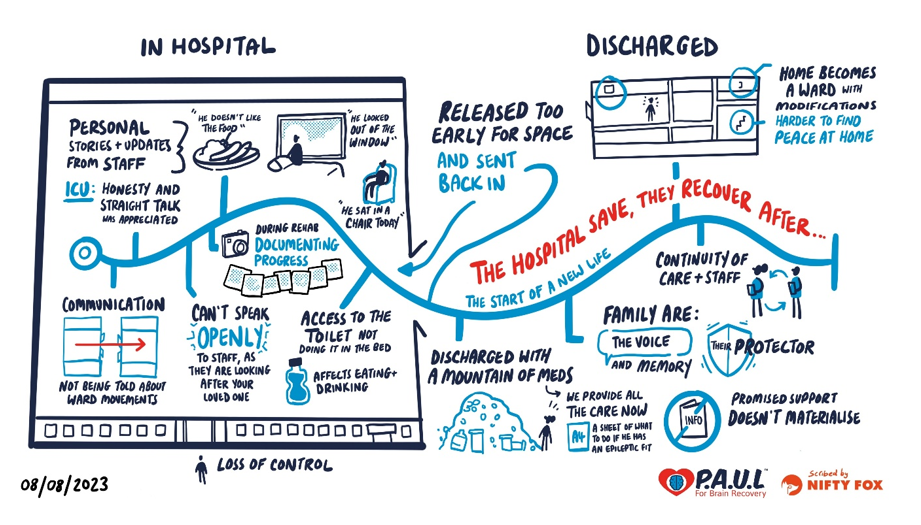
While many participants praised their hospital care, most described feeling isolated and unsupported once their loved one returned home. Some didn’t see themselves as “carers,” which meant they didn’t seek help or even know what support was available. The ripple effects were huge, affecting mental and physical health, finances, and identity.
Families told us about:
- Feeling as though they’d brought home “a different person.”
- Hiding their emotions to stay strong for others.
- Managing care and admin that felt like a full-time job.
- Losing contact with friends and workplaces that couldn’t relate.
- The power of peer support, which helped them feel less alone.
- The importance of hope, which gave them strength to move forward.
Acquired brain injury can be life-changing for the person affected, but also for their entire family. Many families described the transition from hospital to home as one of the hardest stages. Through this project, we’ve seen how community support, like that offered by P.A.U.L for Brain Recovery, can bridge that gap, offering not just guidance but genuine hope.
From Research to Action
All 13 families said they valued being part of the research and wanted more opportunities for carers to share their voices. The findings led directly to an extension of the project, bringing Emma Branch into the team as a dedicated Family Support Worker.
Emma now leads a new family support service offering:
- Education about ABI.
- Creative workshops and peer support sessions.
- Coffee and chat sessions and guest speaker events.
- Resources to help carers care for themselves and connect with others.
Hazel, wife of stroke survivor Brian, shared her experience of accessing the new family support services:
“When my husband had a massive stroke, our world changed overnight. Coming home was overwhelming until I found P.A.U.L for Brain Recovery. Meeting others who understood gave me strength and reminded me I wasn’t alone. P.A.U.L didn’t just help Brian, it gave me a place to breathe, to learn, and to find hope again.”
Reflections from Marrakech
Attending the ISPRM conference was a privilege. We met professionals from around the world and saw firsthand the shared challenges of rehabilitation, fragmented systems, variable access, and the need for earlier intervention.
Being the only charity to present gave us a unique opportunity to show how collaboration between the NHS and community organisations can truly transform outcomes. We were proud to highlight the often unheard voices of families and to show the value of partnership between hospital teams, charities, and communities.
It was incredible to see so many passionate people working to improve rehabilitation worldwide. But we also realised how rare it is for families’ voices to be heard. Our work is helping to change that.
Learning, Connection, and Gratitude
Between sessions, we explored the Marrakech medina, soaked up the colours, sounds, and hospitality, and reflected on how far our project had come, from Hull to an international stage. We also made meaningful connections that will help us continue this work.
We’ve been invited to share our research at a rehabilitation conference at another UK hospital, and we also connected with a sports and rehabilitation physician in Ghana, who is keen to collaborate and share learning to support families living with brain injury in Ghana.
We returned home feeling inspired, proud, and even more determined to keep advocating for families affected by brain injury. We’re deeply grateful to the British Science Association and The Ideas Fund for funding our project and enabling us to share our findings with a global audience. “This experience reminded us that science is at its best when it listens, when it brings people together to share stories, ideas, and hope.”
Find out more
- Explore the work of P.A.U.L for Brain Recovery Home - P.A.U.L For Brain Recovery
- Watch our co-produced animation about family experiences of acquired brain injury here